The word botany in a barista context doesn’t mean a magnifying glass over a houseplant. It means tools that let you read coffee at its botanical level—green bean structure, moisture content, dissolved solids concentration, and defect classification. These are the same instruments roasters, Q Graders, and specialty importers use before a single bean hits the roaster. For a barista, they answer the question: what am I actually brewing, and why does it taste the way it does?
Affiliate Disclosure: This post contains affiliate links. If you purchase through these links, we may earn a commission at no additional cost to you.
Why a Barista Needs Botany Equipment
Coffee is a fruit. Coffea arabica produces a cherry whose anatomy—from the waxy exocarp to the inner parchment—shapes fermentation, processing, and ultimately flavor (coffee cherry anatomy guide). Understanding that botanical reality lets you make different decisions than a barista who only sees a brown bag labeled “Ethiopia Yirgacheffe.” It helps you evaluate green coffee quality, spot processing errors before roasting, and use TDS data to tune extraction with evidence instead of guesswork.
These tools are most valuable for baristas at specialty shops, roastery operators, and advanced home brewers who want to connect botanical science to daily extraction decisions. Gaggia’s home barista glossary notes that “every variable, from the choice of coffee to the extraction, plays a role in the final result”—and these instruments make those variables measurable.
1. 10× Magnifying Glass for Green Bean Inspection
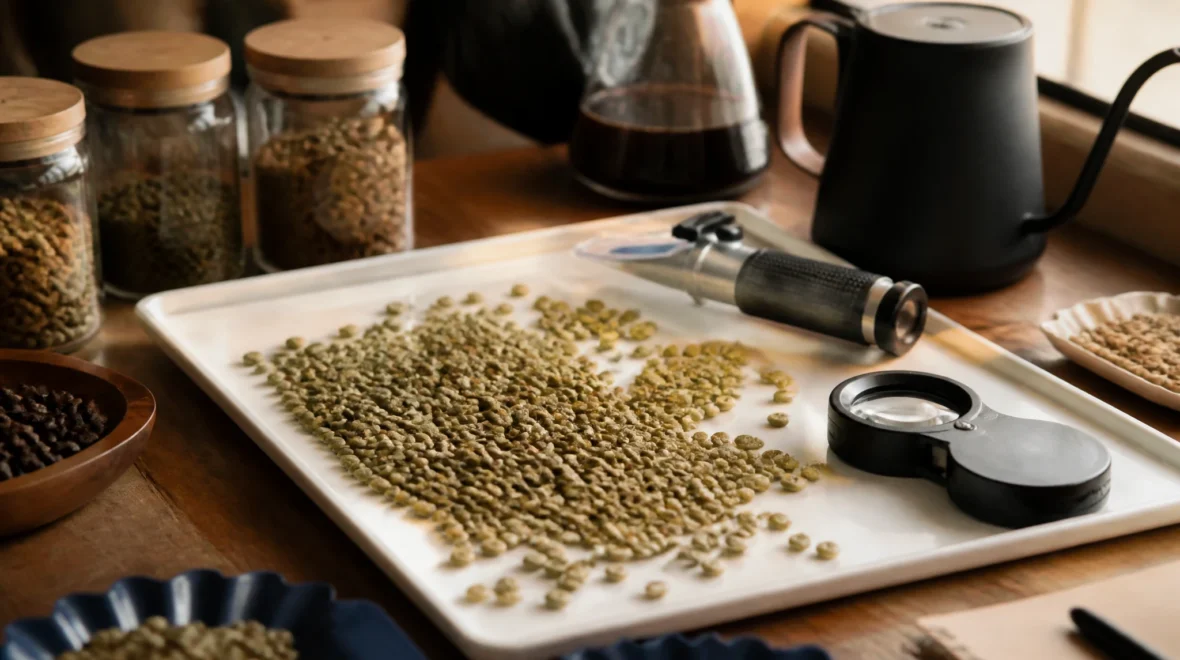
A simple 10× magnifier lets you examine green coffee beans at a level that reveals the difference between a specialty lot and a commercial one. You can spot insect damage, identify partial black or sour beans, and observe surface texture differences between washed and natural-processed lots.
Professional green coffee inspection relies on visual examination as the first step. The Specialty Coffee Association (SCA) classifies green coffee defects on 350 g samples using primary and secondary defect categories. A magnifier helps you see defects that casual inspection misses—micro-cracks in parchment, early signs of fungal discoloration, and the structural differences between properly ripe and underripe seeds.
What to look for: A standard 10× jeweler’s loupe or handheld magnifier costs $5–15. You don’t need anything exotic—just clean optics and a comfortable grip for extended inspection sessions.
2. White Sorting Tray / Defect Board
White sorting trays are the standard surface for green coffee defect grading. The SCA protocol calls for spreading a 350 g sample on a white board so that dark defects—black beans, sour beans, charcoal—stand out against the light background. This is the foundation of green coffee quality assessment before roasting.
Espresso Academy’s guide to SCA green coffee defects describes the classification system: primary defects (full black, full sour, dried cherry, foreign matter) that disqualify a lot from specialty status, and secondary defects (partial black, parchments, floaters, shells) that are tolerated only up to a defined threshold per 350 g sample. A clean white tray is essential equipment for applying this framework.
What to look for: Specialty suppliers like Baruch Coffea sell dedicated green coffee sample trays in multiple sizes. White porcelain or plastic boards work equally well. The key is a smooth, non-porous surface that’s easy to clean and provides high contrast against coffee beans.
3. TDS Refractometer
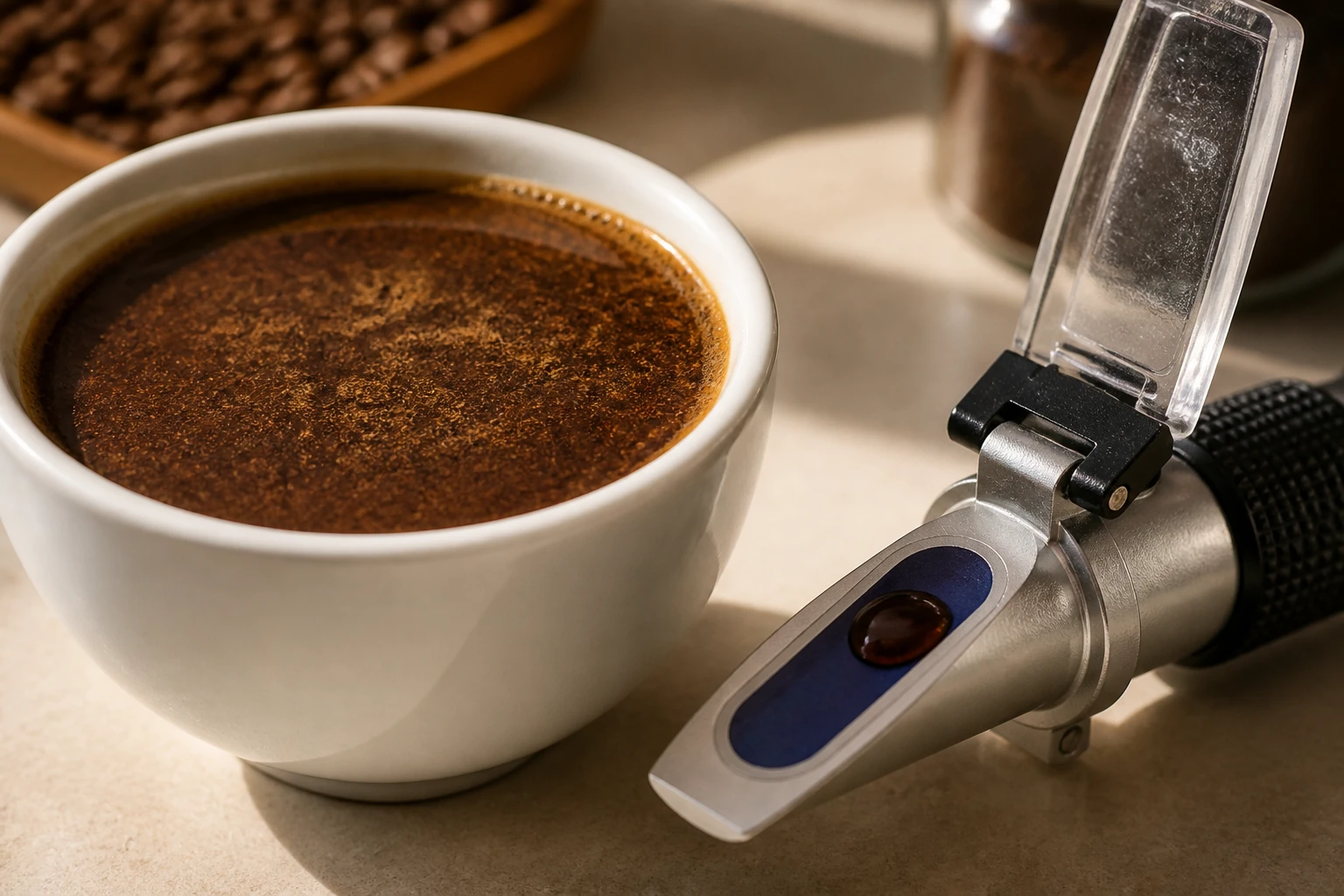
A refractometer measures Total Dissolved Solids—the concentration of dissolved coffee material in your brew. It works by measuring the angle at which light bends through a liquid, which correlates directly to how much coffee is actually in the water.
The industry standard is the ATAGO PAL-COFFEE line, which comes in three configurations (Brix only, TDS only, or both). According to ATAGO’s specifications, the PAL-COFFEE(BX/TDS) measures Brix from 0.00–25.00% and TDS from 0.00–22.00%, with a resolution of 0.01% and an accuracy of ±0.10% for Brix and ±0.15% for TDS. It requires just 2–3 drops, delivers a reading in about 3 seconds, is IP65 water-resistant, and runs on two AAA batteries. Atago lists the price at $361 USD.
Why does this matter for a barista? Because TDS tells you whether your brew is under- or over-extracted independent of taste perception. Fellow Products and Barista Hustle both explain that TDS combined with a brew ratio gives you the extraction yield—a number that lets you reproduce successful shots and systematically adjust grind, dose, or water temperature.
What to look for: The PAL-COFFEE line is the most widely used. Alternatives exist, but Atago dominates the refractometer market—roughly 80% in Japan and 30% overseas, according to Atago’s own page. The key specs to compare are resolution (0.01% is the standard for specialty coffee), temperature compensation, and sample volume.
4. Coffee Moisture Meter
Moisture content in green coffee typically sits between 10–12%. Beans outside this range extract differently and develop differently under heat. Too dry and the beans crack aggressively during roasting; too wet and fermentation risks increase during storage.
The Draminski TG PRO is the most widely referenced moisture meter for coffee and cocoa. According to Draminski’s documentation and Showroom Coffee, it features a stainless steel housing, a backlit screen showing moisture and temperature readings, internal memory for 50,000 results with timestamps, USB connectivity for data export, and an external temperature probe. It measures both green and roasted beans.
For a roaster or barista sourcing green coffee directly, a moisture meter is a quality control tool. It tells you whether a supplier’s green coffee is within spec and whether your storage environment is keeping beans stable. Without one, you’re working blind on moisture—a variable that directly affects roast development and extraction behavior.
This is an editorial inference: a moisture meter is most relevant for baristas who roast or handle green coffee in-house, not for those who buy roasted beans from a third party.
5. SCA Green Coffee Defect Handbook (Physical or Digital)
You can’t use a sorting tray or magnifier effectively without knowing what to look for. The SCA Green Arabica Coffee Classification System poster and the accompanying Green Arabica Coffee Defect Handbook are the reference standards for defect identification. The handbook is a flipchart-style reference with photographic samples of primary and secondary defects, defect equivalence values, and grading protocols.
Espresso Academy notes that “the SCA developed a precise classification of defects, divided into primary and secondary, with clear rules that define when a coffee can be considered specialty.” The poster and handbook give you the visual vocabulary to apply those rules. Barista Life’s defects identification guide also provides training context on how these tools fit into a professional quality-control workflow.
What to look for: The SCA sells the handbook as a physical flipchart or a digital download, and the poster as a PDF. Prices range from roughly $10 (PDF poster) to $35 (handbook download). Third-party sellers like Barista Warehouse US carry the durable flipchart version.
Before You Buy: A Practical Checklist
Not every barista needs all of these tools. Here’s how to prioritize based on your role:
- Shop barista (roasted beans only): Start with a magnifier and white tray. Pair with the SCA defect handbook. This gives you botanical knowledge of what you’re serving without the equipment investment of a refractometer or moisture meter.
- Roastery operator: Add a moisture meter and TDS refractometer. Green coffee QC and roasted product consistency depend on both.
- Advanced home brewer: A magnifier and white tray build botanical literacy. A TDS refractometer (like the Atago PAL-COFFEE) is the single most useful lab tool for dialing in extraction.
If you already use professional cupping tools for flavor evaluation, these botany instruments extend that practice one step upstream—to the green bean itself. They complement the tasting skills you’ve already developed by giving you physical, measurable data about the coffee before it enters the cup.
Summary: Botany Equipment for Baristas
| Tool | Purpose | Price Range | Who Needs It |
|---|---|---|---|
| 10× magnifying glass | Green bean defect inspection | $5–15 | All baristas interested in bean quality |
| White sorting tray | SCA defect grading surface | $10–30 | Roasters, shop baristas |
| TDS refractometer | Measure dissolved solids / extraction | $200–400 | Roasters, advanced home brewers |
| Moisture meter | Green bean moisture QC | $300–600 | Roasters, green coffee handlers |
| SCA defect handbook | Defect identification reference | $10–35 | Everyone using a sorting tray |
Botany equipment for baristas isn’t about turning your espresso bar into a lab. It’s about connecting what’s in the cup to what was growing on a tree—down to moisture content, bean density, and defect classification. The tools below the $50 total (magnifier, tray, handbook) give you the botanical literacy to understand your coffee. The instruments above $200 (refractometer, moisture meter) add quantitative precision.
CoffeeLogik did not test these products in person. Specifications for the ATAGO PAL-COFFEE are from Atago’s direct product page; green coffee defect classification follows the SCA framework as described by Espresso Academy; moisture meter details come from Draminski’s documentation and Showroom Coffee. This is not hands-on testing—these are manufacturer specifications and published industry standards.