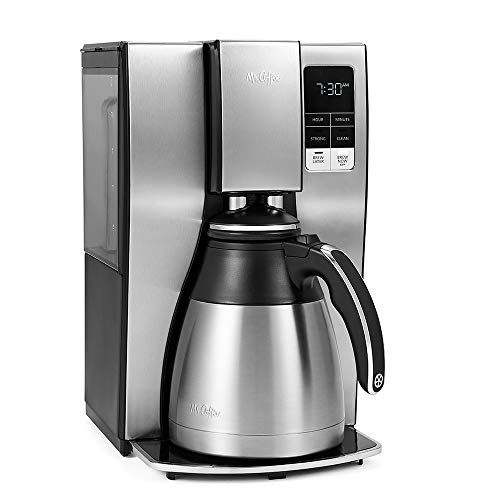
The Mr. Coffee Optimal Brew is a 10-cup programmable machine with a double-walled stainless thermal carafe instead of a glass pot on a hotplate. Its defining design choice is a lid that’s sealed rather than removable, and that one decision explains most of what’s good and annoying about owning it.
The lid stays shut on purpose
Mr. Coffee’s own product page is explicit about this: the carafe lid “is designed to stay in place for optimal heat retention” rather than twisting off. That’s a real engineering tradeoff, not an oversight. A carafe that seals shut holds heat longer than one with a loose or removable lid, because there’s no gap for warm air to escape. The cost is on the cleaning side — you can’t easily open the carafe to scrub the interior, so rinsing and the occasional descaling cycle have to do the work a full open-mouth wash would otherwise handle.
The 205°F figure is Mr. Coffee’s claim, and a related model backs it up
The manufacturer advertises “a high brew temperature of up to 205°,” and brewing 20% faster than comparable machines. We didn’t find independent lab testing of this exact model, but Consumer Reports tested the closely related BVMC-PSTX95 — same Optimal Brew thermal line — and found it “met recommended guidelines of 195°F or more, maintained for five or six minutes,” with a measured capacity of 50oz. That’s not a direct substitute for testing this specific unit, but it’s a reasonable signal that the Optimal Brew thermal platform generally runs hot enough rather than falling short the way some budget machines do.
The carafe itself is the recurring complaint
Consumer Reports’ testing of the related PSTX95 flagged the carafe as “not especially easy to use,” citing an uncomfortable handle, dripping while pouring, balance issues when the carafe is full, and difficulty emptying it out completely. Given that the sealed-lid design is shared across the line, it’s reasonable to expect similar pouring behavior on this model — the same seal that keeps heat in also limits how the carafe can be shaped around the spout.
What else is on the machine
A water filtration disk is rated to remove up to 97% of chlorine from tap water, there’s a gold-tone permanent filter so you’re not required to buy paper filters, a delay-brew timer, a “Grab-A-Cup” auto-pause for mid-brew pours, a 4-hour automatic shutoff, and a freshness timer that tracks how long coffee has been sitting in the carafe. The water reservoir is removable for filling at the sink, which is a small but genuine convenience the Café Specialty Drip and Braun BrewSense on this list both lack.
Before you buy
- Plan to clean the carafe through its opening rather than a full interior scrub; the lid doesn’t come off.
- Pour deliberately — a related model in the same line showed dripping and balance issues when full.
- Confirm you’re buying the current model number; Mr. Coffee has sold several similar Optimal Brew thermal machines under different SKUs.
- Use the built-in permanent filter if you’d rather not keep paper filters stocked.
- Check the warranty terms with the retailer at time of purchase.
Manufacturer specifications from Mr. Coffee’s product page; independent test results from Consumer Reports’ review of the related BVMC-PSTX95 model in the same Optimal Brew thermal line. CoffeeLogik has not tested this machine in person.