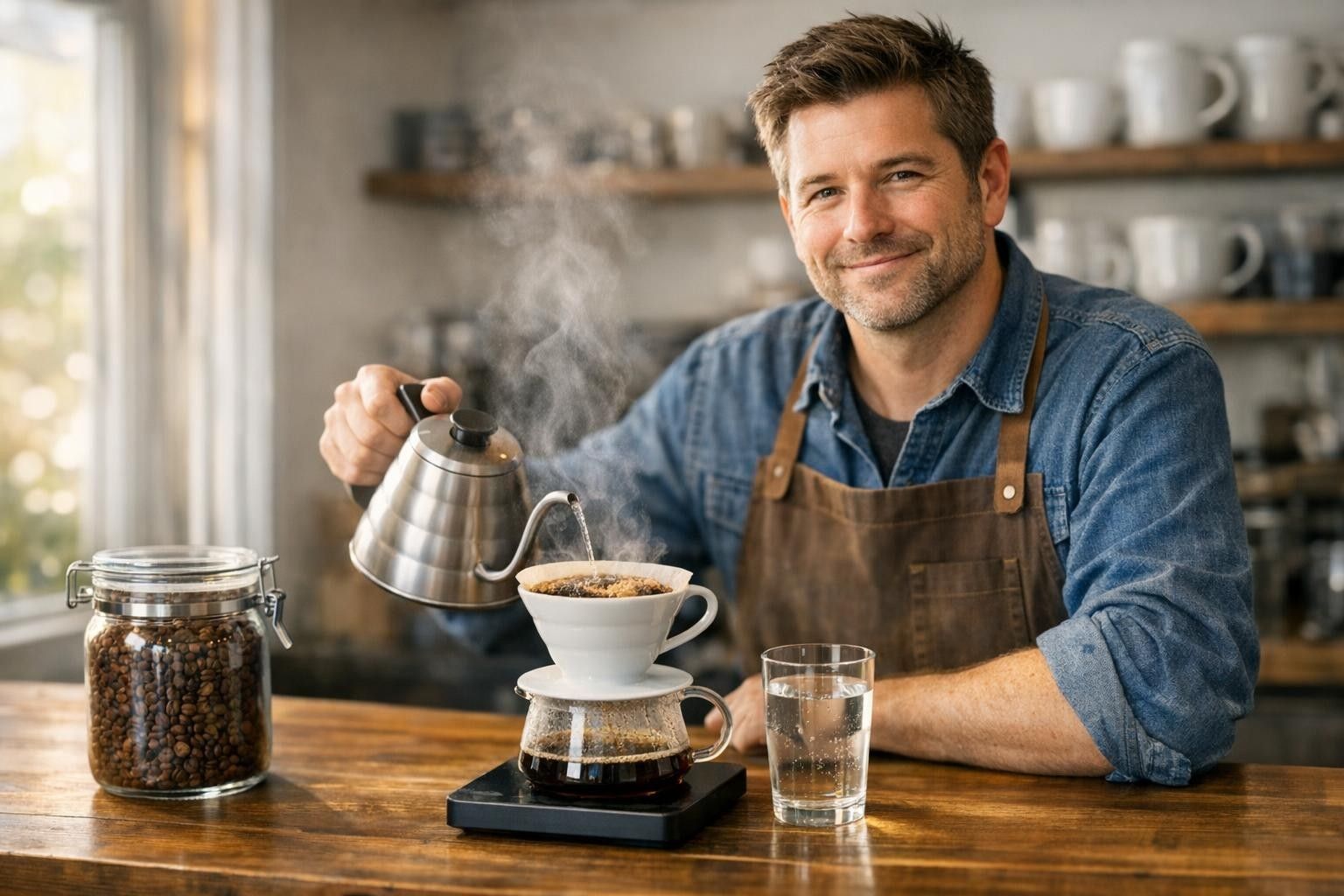
The first clue your coffee is going sideways usually hits before you even taste it.
Affiliate disclosure: This post contains affiliate links. As an Amazon Associate we earn from qualifying purchases, at no extra cost to you. Details.
You pour a cup, take a sip… and it’s either thin and sour like lemon water, or bitter and ashy like you licked a charcoal briquette. Meanwhile, the kitchen smells incredible—warm caramel, toasted nuts, maybe a little orange peel—so why does the cup taste like it lost its will to live?
I’m Imani Wells. I’ve owned a neighborhood café in the Midwest for over a decade, and I’ve watched hundreds of “bad coffee” mysteries get solved right at the counter—usually in under five minutes.
Here’s the surprising truth: most bad coffee isn’t “bad coffee.” It’s coffee that got sabotaged by one of four usual suspects: stale beans, rough water, off extraction, or dirty equipment. If you fix even one of those, your morning cup stops tasting like punishment and starts tasting like something you’d proudly serve a friend.
1) Your Beans Aren’t “Bad”—They’re Just Tired
The smell test you can do in 3 seconds
Open your bag and take a deep sniff. Fresh coffee should hit you with something vivid: cocoa powder, berries, brown sugar, maybe a floral pop like jasmine if it’s a washed Ethiopian.
If you’re getting “cardboard,” “dust,” or that flat pantry smell? The coffee isn’t terrible. It’s just past its best window.
Most specialty coffee tastes brightest between about day 4 and day 21 after roast. Earlier than that, it can taste a little gassy and unsettled. Much later, you start losing the volatile aromatics—the stuff that makes a Colombia Huila taste like red apple and panela instead of plain “coffee-ish.”
What to buy (and what to ignore)
Ignore “best by” dates when you can. Look for a roast date.
If you want a real-world benchmark, grab something like Counter Culture Hologram or Intelligentsia Black Cat and compare it to a grocery-store bag with no roast date. The fresh one will smell like chocolate and dried fruit. The old one will smell… polite.
Understanding why ‘fresh’ beans peak 2 weeks later can help you time your coffee purchases for maximum flavor.
Actionable fixes (do these today)
Buy smaller bags more often. A 10–12 oz bag you finish in 10 days beats a 2-pounder that limps along for six weeks.
Store it like you mean it. Keep coffee in an airtight container (Airscape is great) in a cool cabinet. Not the fridge. Not next to the stove.
And please—don’t freeze half-used bags unless you’re portioning and sealing properly. Freezing can be amazing when done right, but a bag that gets opened and closed in a humid freezer turns stale in a weird, papery way. Those coffee bag valves you see on bags? They’re designed to keep beans fresh, but only if you understand how they work.
If your beans are already tired, here’s the bartender-style move: brew it as cold brew. Stale flavors hide better cold, and you’ll still get a pleasant chocolatey sweetness.
2) Your Tap Water Might Be Quietly Ruining Your Coffee
The Midwest water reality check
I love the Midwest. I do not love what our water can do to a coffee brewer.
If your water is very hard, coffee can taste dull and chalky, like the flavor got wrapped in a wool blanket. If it’s over-soft or heavily filtered down to nothing, coffee can taste sharp, hollow, and oddly salty.
The Specialty Coffee Association’s target zone is a helpful compass: roughly 50–175 ppm total hardness (as CaCO3) and around 40 ppm alkalinity. You don’t need a lab coat, but you do need to know that water isn’t neutral—it’s an ingredient.
The easiest test: taste your water warm
Pour a glass of your tap water and taste it at room temp.
If it tastes like a swimming pool, pennies, or wet limestone, it’s going to bully your coffee. Those bright notes—like the citrus-forward sparkle of a washed Kenya—get flattened fast.
Actionable fixes (simple to slightly nerdy)
Start with a basic filter. A Brita Elite or ZeroWater (with remineralization) can be a night-and-day shift.
If you want café-level consistency without the headache, use Third Wave Water minerals with distilled water. I’ve had customers come back genuinely mad that they didn’t try it sooner.
And here’s a specific, easy win: stop brewing with water that’s too cool.
For most pour-over and drip, aim for 200°F–205°F (93°C–96°C) at the kettle. If you don’t have a variable-temp kettle, boil the water, then let it sit 30–60 seconds before brewing.
When water is too cool, you get that “sour, underdeveloped” cup—like someone waved a lemon over it and called it a day.
3) Extraction: The Sour/Bitter Problem Is a Math Problem (In a Friendly Way)
The cup is telling you what went wrong
Here’s how it plays out at my café counter:
Someone says, “My coffee tastes bad.”
I ask, “Does it taste sour or bitter?”
Because those are two different problems.
Sour, thin, sharp usually means under-extraction—you didn’t pull enough sweetness and body from the grounds. Think grapefruit pith, watery texture, a quick fade.
Bitter, dry, ashy usually means over-extraction—you pulled too much, including the harsh compounds. The finish clings like over-steeped black tea.
Start with a ratio you can trust
If you only change one thing, make it this: stop scooping and start weighing.
A dependable starting point for drip/pour-over is 1:16.
That means:
- 20 g coffee to 320 g water
- 30 g coffee to 480 g water
If your coffee tastes hollow, go a little stronger: 1:15.
If it tastes heavy and muddy, go a little weaker: 1:17.
Grind size is your steering wheel
If your ratio is reasonable and the cup still tastes off, grind is usually the culprit.
If it’s sour and thin, grind finer.
If it’s bitter and drying, grind coarser.
This is where equipment matters in a very unsexy way. A blade grinder gives you boulders and dust at the same time, which creates a cup that’s both sour and bitter—confusing and exhausting.
A solid entry burr grinder like a Baratza Encore will clean up your flavor fast. If you want a step up for filter coffee, the Fellow Ode Gen 2 is a beautiful, consistent grinder that makes sweetness easier to hit.
Timeframes that keep you out of trouble
Use time like guardrails:
- V60 (Hario V60 02): aim for 2:45–3:30 total brew time for ~300–500 g brews.
- French press: 4:00 steep, then plunge gently.
- AeroPress: 1:30–2:30 total, depending on recipe.
If your V60 is finishing in 1:45, you’re probably too coarse or pouring too aggressively. If it’s dragging past 4:30, you’re likely too fine or choking the filter.
If you want to get extra nerdy (I say that affectionately), most great filter coffee lands around 18–22% extraction yield and 1.15–1.35% TDS. You don’t need a refractometer to brew delicious coffee, but those numbers are why “a little finer” sometimes changes everything. How temperature unlocks different flavor phases during your brew can also dramatically impact extraction and taste.
Actionable fixes (the 10-minute rescue)
Tomorrow morning, do this:
Weigh 20 g coffee, grind medium-fine (table salt-ish), and brew with 320 g water at 203°F.
Taste it. If it’s sour, go finer one click. If it’s bitter, go coarser one click.
That tiny adjustment—one click—beats randomly changing five things and blaming the beans.
4) Your Coffee Maker Is Probably Dirty (I Say This With Love)
The bitter flavor that isn’t “dark roast”
Old coffee oils go rancid. They don’t announce themselves dramatically. They just sneak into your brew and leave a greasy, stale finish—like peanut shells and cigarette paper.
If your brewer smells “old” even after you rinse it, that’s not your imagination.
In cafés, we’re relentless about cleaning because yesterday’s oils will absolutely bulldoze today’s strawberry-and-cream natural Ethiopia.
At home, it’s easy to forget… until every cup starts tasting the same kind of bad.
The places funk loves to hide
Your grinder chute. The lid of your bean hopper. The rubber gasket on your French press. The little showerhead on a drip machine.
And if you have an espresso setup—say a Breville Barista Express—your portafilter and shower screen can hold onto old oils that turn a sweet shot into something harsh and metallic.

Actionable fixes (simple routine, big payoff)
For drip machines like a Technivorm Moccamaster, wash the brew basket and carafe with fragrance-free soap every few uses. Oils cling to glass and plastic.
Descale monthly if your water is hard. Use a coffee-safe descaler like Urnex Dezcal. Your machine will run hotter and more consistent—temperature stability matters more than most people realize.
For grinders, brush out the chute weekly. Run Urnex Grindz about once a month if you’re grinding daily.
For espresso machines, backflush with Cafiza (if your machine supports it) and soak the portafilter basket. The first clean after “a long time” is always the most dramatic—like opening a window in a stuffy room.
Here’s my promise: a clean brewer makes your coffee taste sweeter without you changing a single bean.
Conclusion: Fix One Thing, Then Come Tell Me What Changed
I’ve watched people chase their tails for years—buying fancier beans, pricier gadgets, posting desperate questions online—when the real fix was as simple as fresh coffee, filtered water, a 1:16 ratio, and a brewer that doesn’t smell like last month.
Tomorrow, pick just one lever. Weigh your dose. Or clean your grinder. Or brew at 203°F instead of “kinda hot.”
And when you get that first cup that’s finally right—sweet like caramel, bright like orange zest, with a silky body that hangs around—you’ll remember this: coffee isn’t supposed to taste like a compromise.
If you want, bring your setup questions to my little corner of the Midwest. I’ll be the one behind the bar, listening for that first sip and the quiet, surprised, “Oh… there it is.”

