The Hario V60 is a cone-shaped pour-over dripper from Hario, a Japanese glassware company founded in 1921. The design was finalized in 2004 and takes its name from the 60-degree angle of the cone. It is inexpensive, it is used in cafés all over the world, and it makes a clean, bright cup once you have the basics down.
This guide covers the parts that matter before you buy one: how the V60 differs from other drippers, which size and material to choose, what else you need, and a simple recipe to start with.
Quick pick
Hario V60 plastic dripper, size 02. It is the cheapest version, holds heat well, is very hard to break, and brews one to four cups.
What makes the V60 different
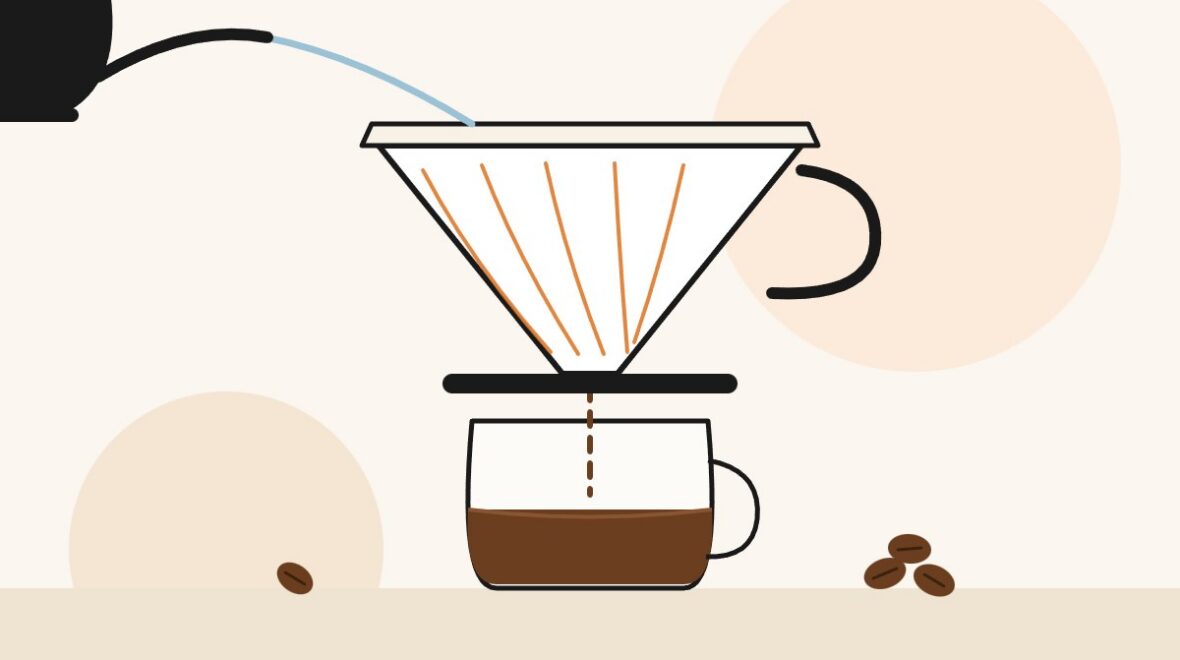
Most drippers slow the water down for you. The V60 mostly does not, which is why it gives you more control and less room for error.
- One large hole. Water leaves the cone quickly, so your grind size and how fast you pour decide the brew time. Drippers like the Kalita Wave or Melitta use small holes that hold water back.
- Spiral ribs. The raised ridges inside the cone keep the paper filter from sealing against the wall, so air can escape and water can flow down and out.
- A deep, 60-degree cone. The coffee bed is thickest in the middle, and water passes through it rather than sitting on top of it.
In practice this means small changes in grind or pouring show up in the cup. That is the appeal for many people, and the reason a scale and a gooseneck kettle make such a difference with this brewer.
Which V60 to buy
Size
Each size takes its own filters, so buy papers that match the number on your dripper.
Material
Once a dripper is preheated, the difference in the cup between materials is small. Choose on price, durability and looks.
What else you need
- Filters. Hario V60 paper filters, size 02 (natural). Natural (unbleached) papers like these need a good rinse; white papers need less.
- A burr grinder. Pre-ground coffee is usually too fine or too coarse for a V60 and goes stale quickly. The Baratza Encore is a common electric starting point; the TIMEMORE Chestnut C2 is a well-regarded hand grinder.
- A gooseneck kettle. The thin spout lets you pour slowly and aim the water. The COSORI Gooseneck Electric Kettle has temperature control at a mid-range price; the Fellow Stagg EKG Pro is the premium option.
- A scale with a timer. Weighing coffee and water is the easiest way to get repeatable results. The Hario V60 Drip Scale reads to 0.1 g and has a built-in timer.
- A mug or server that the dripper sits on securely.
A simple V60 recipe for one mug
15 g coffee · 250 g water (about 1:16.7) · medium-fine grind, a little finer than table salt · water at 93–96 °C (200–205 °F) · total time 2:30–3:30
Rinse the filter
Fold the paper along its seam, set it in the dripper and pour hot water through it. This preheats the dripper and rinses out paper taste. Pour that water away. (More on rinsing filters.)
Add the coffee
Add 15 g of ground coffee, shake gently to level the bed, place everything on the scale and zero it.
Bloom (0:00–0:40)
Pour about 40 g of water, enough to wet all the grounds, then give the dripper a gentle swirl. Fresh coffee will rise and bubble as it releases carbon dioxide. (Why the bloom matters.)
First main pour (0:40–1:15)
Pour in slow circles from the center outward and back, up to 150 g. Avoid pouring straight onto the paper at the edges.
Second pour (1:15–1:45)
Continue the same way up to 250 g, then give the dripper one more gentle swirl so the bed settles flat.
Let it drain
Aim for the water to finish draining somewhere between 2:30 and 3:30. A flat bed of grounds at the end is a good sign the water passed through evenly.
How to adjust it
Change one thing at a time, starting with grind size.
- Sour, thin, or it drained before 2:30: grind finer.
- Bitter, dry, or it took longer than about 3:45: grind coarser. (Troubleshooting bitter pour-over.)
- Tastes good but too strong or too weak: keep the grind and change the ratio. Anywhere from 1:15 to 1:17 is normal. (Coffee ratio guide.)
- Drains very slowly or stalls: the grind may be too fine, or water poured down the side may be running around the coffee instead of through it.
For help picking a starting setting on your grinder, see the grind size guide.
Two well-known recipes to try next
Tetsu Kasuya’s 4:6 method
Tetsu Kasuya used this method to win the 2016 World Brewers Cup. It uses 20 g of coffee and 300 g of water, a coarser grind than usual, and five pours of 60 g each, roughly 45 seconds apart. The first two pours (the “40”) adjust sweetness and acidity: make the first one smaller for a sweeter cup or larger for a brighter one. The last three pours (the “60”) adjust strength: fewer, larger pours make a lighter cup, more pours make a stronger one.
James Hoffmann’s V60 technique
This widely shared technique uses 30 g of coffee and 500 g of water for two or three cups. Bloom with about 60 g for 45 seconds, pour to 300 g over the next 30 seconds, then to 500 g over the following 30 seconds, stir gently, give the dripper a swirl and let it drain. It aims to finish around 3:30.
V60 vs other drippers
If you are still deciding between pour-over and immersion brewing in general, see French press vs pour over.
Frequently asked questions
Do I need a gooseneck kettle?
It is not required, but it helps a lot with the V60 because the dripper does not slow the water down for you. Without one, pour slowly from a regular kettle into a small jug or measuring cup first, and pour from that.
Bleached or unbleached filters?
Both work. Unbleached (brown) papers tend to leave more paper taste, so rinse them well. Bleached papers need only a quick rinse.
Can I make iced coffee with a V60?
Yes. Put ice in the server and brew a stronger, smaller amount of hot coffee over it. A common starting point is 15 g of coffee, 150 g of hot water in the dripper and 100 g of ice in the server, with a slightly finer grind.
Size 01 or 02?
If you only ever make one mug, the 01 works. The 02 handles one mug just as well and can also brew for two, which is why it is the more common choice.
Related guides
- Coffee bloom explained
- How to fix bitter pour-over coffee
- Coffee ratio guide
- Should you rinse paper filters?
- Building a home coffee bar
How this guide was made: research-based, drawing on Hario’s published specifications, roaster brew guides and widely published recipes. CoffeeLogik has not lab-tested these products. How we review.